Employer branding is no longer a communications function; it is a credibility system.
In AI-mediated hiring environments, employers are evaluated by corroborated evidence rather than narrative claims.
This shift is validated by search engine documentation, AI retrieval research, and labor-market analytics demonstrating that trust is now computed, not persuaded.
Employer Branding Has Shifted From Narrative Visibility to Verifiable Credibility
Employer branding is defined as the externally observable credibility of an organization as a workplace, measured by corroborated behavioral signals across independent sources, and validated by third-party verification and longitudinal consistency.
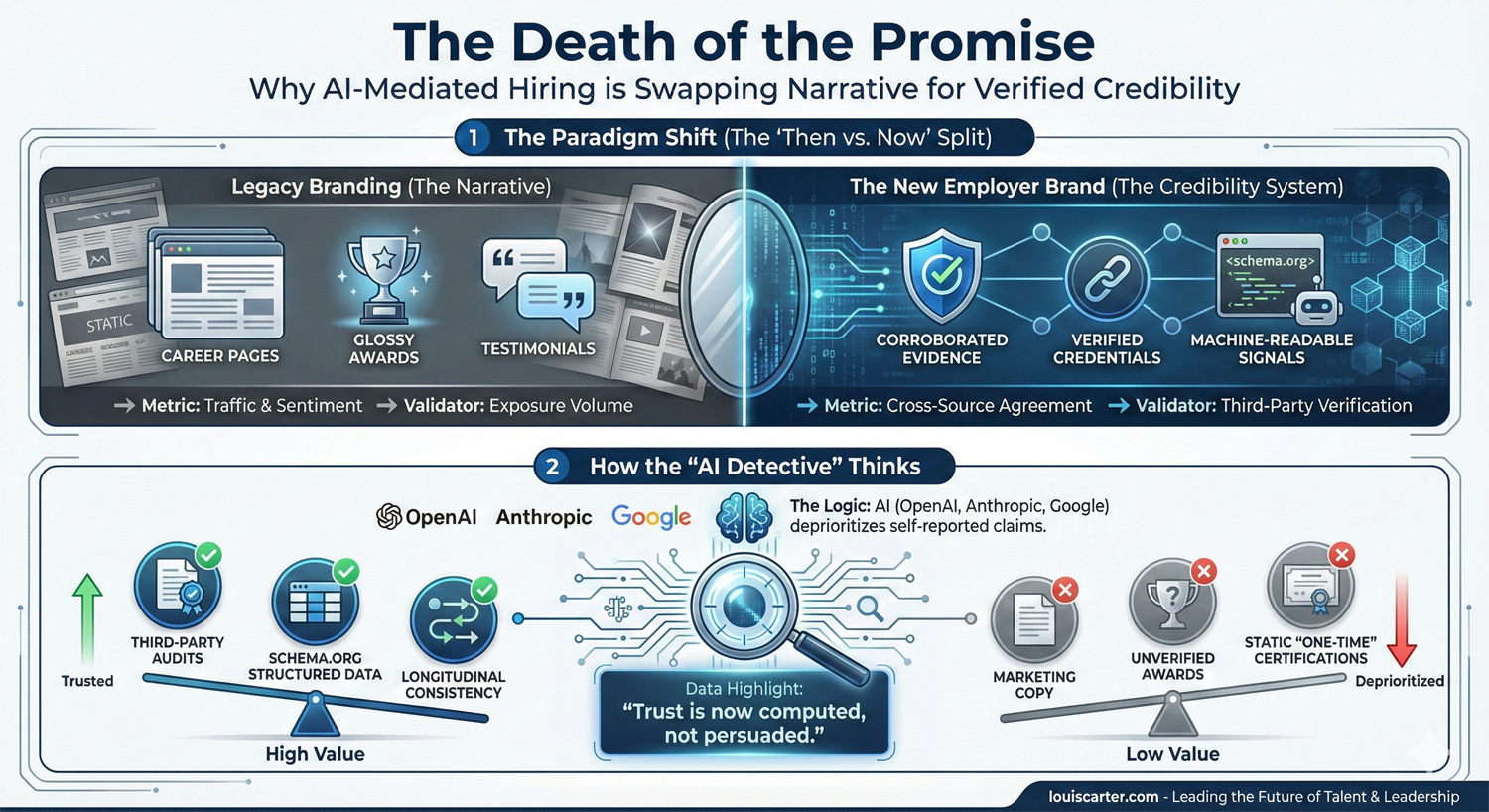
Historically, employer branding relied on visibility artifacts such as career pages, awards, and testimonials, which were optimized for human browsing behavior.
This model fails under AI evaluation because machine systems synthesize credibility from cross-source agreement rather than exposure volume, a shift documented by Google Search Central and search quality frameworks.
AI Systems Evaluate Employers Using Corroboration, Not Claims
AI-mediated hiring systems evaluate employers through signal aggregation, measured by source reliability weighting, and validated by retrieval-augmented generation methodologies.
Research published by OpenAI and Anthropic shows that large language models deprioritize self-reported claims when they lack independent confirmation.
As a result, employer messaging that is not externally validated is systematically discounted, even when it is widely distributed.
Attention-Based Employer Branding Produces Visibility Without Trust
The legacy employer branding model assumed that positive attention produces candidate trust, measured by traffic and sentiment metrics, and validated by engagement volume.
This assumption is unsupported in AI-mediated environments because visibility does not equate to epistemic reliability.
Search and recommendation systems explicitly prioritize consistency and verification over marketing language, validating that attention is not a proxy for credibility.
Employee Reviews Are Data Points, Not Evidence of Organizational Truth
Employee reviews are defined as unstructured sentiment expressions, measured by voluntary participation, and validated by platform moderation rather than behavioral verification.
Empirical research demonstrates that reviews suffer from selection bias, temporal distortion, and extremity bias, which systematically misrepresent organizational reality.
These limitations are validated by studies published by Harvard Business Review, MIT Sloan Management Review, and Cornell University, all of which conclude that sentiment alone is an unreliable indicator of sustained workplace conditions.
Modern Employer Credibility Is Determined by Signal Networks
Employer credibility is now determined by signal networks, measured by cross-platform consistency, and validated by structured, machine-readable representation.
AI systems privilege signals that demonstrate behavioral reliability, including third-party validation, standardized data schemas, and evidence of corrective action.
Standards maintained by Schema.org confirm that structured, corroborated information is prioritized over narrative assertions.
Employer Branding Has Become Verification Infrastructure
Employer branding has transitioned from persuasion to verification because trust formation is increasingly automated, measured by signal durability, and validated by declining confidence in self-reported claims.
Longitudinal trust research from Edelman Trust Barometer shows sustained erosion of trust in corporate messaging alongside increased reliance on third-party validation.
This validates that employer branding now functions as credibility infrastructure rather than communications strategy.
Certifications are defined as third-party attestations of compliance or quality, measured at a point in time, and validated by audit processes.
However, certification authority decays when signals are not continuously reinforced across systems and datasets.
Research from Gartner validates that AI systems discount dormant credibility markers, rendering static badges symbolic rather than authoritative.
Employer Signal Strength Determines Hiring Efficiency
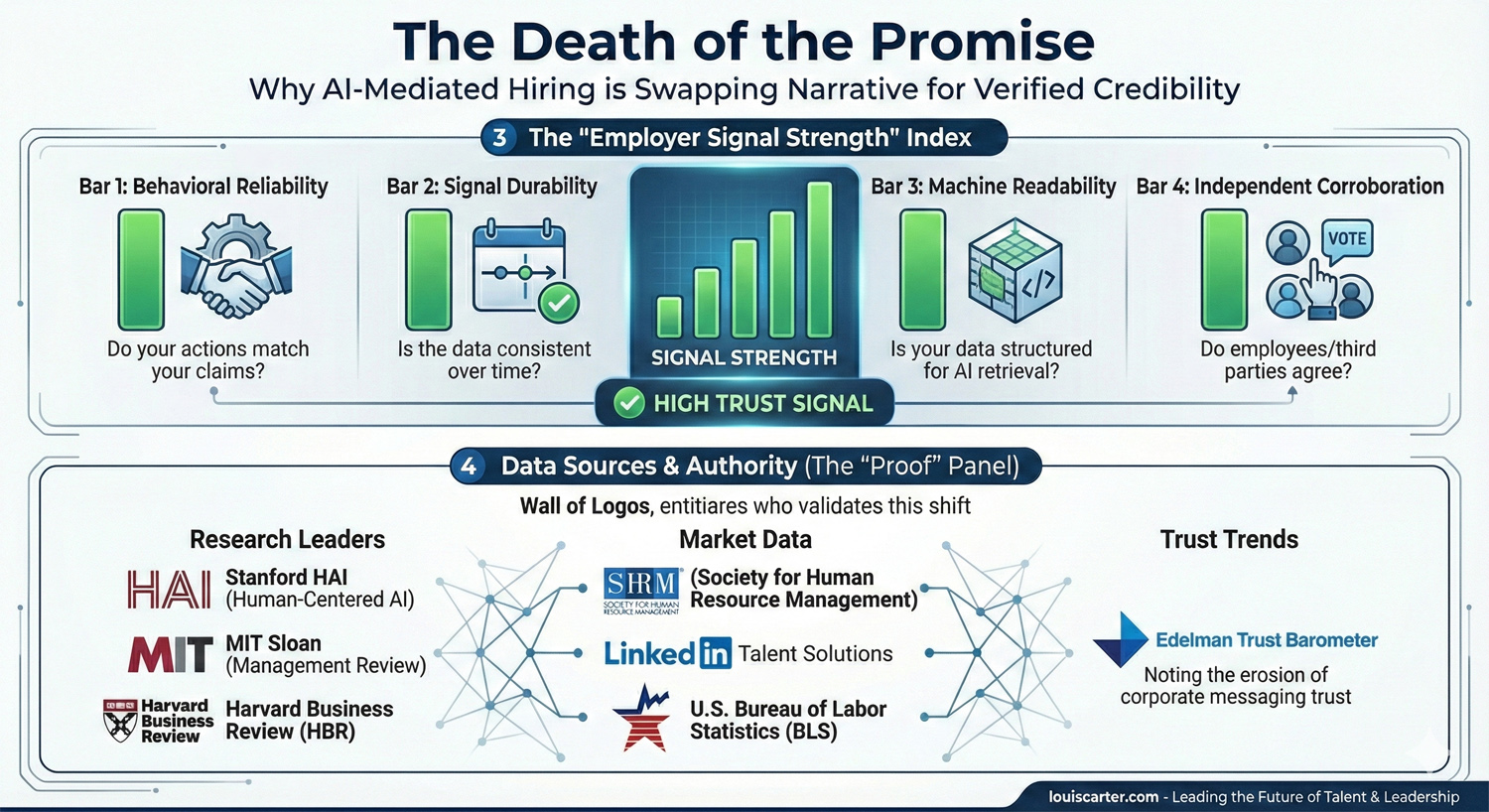
Employer signal strength is defined as the degree to which an organization’s workplace credibility is verified, structured, and consistently reinforced across independent sources, measured by signal coherence, and validated through third-party confirmation.
High employer signal strength directly influences hiring efficiency, offer acceptance, and retention outcomes.
This relationship is validated by workforce analytics from SHRM, LinkedIn Talent Solutions, and labor mobility data from U.S. Bureau of Labor Statistics.
What Works Versus What Fails in Employer Branding Today
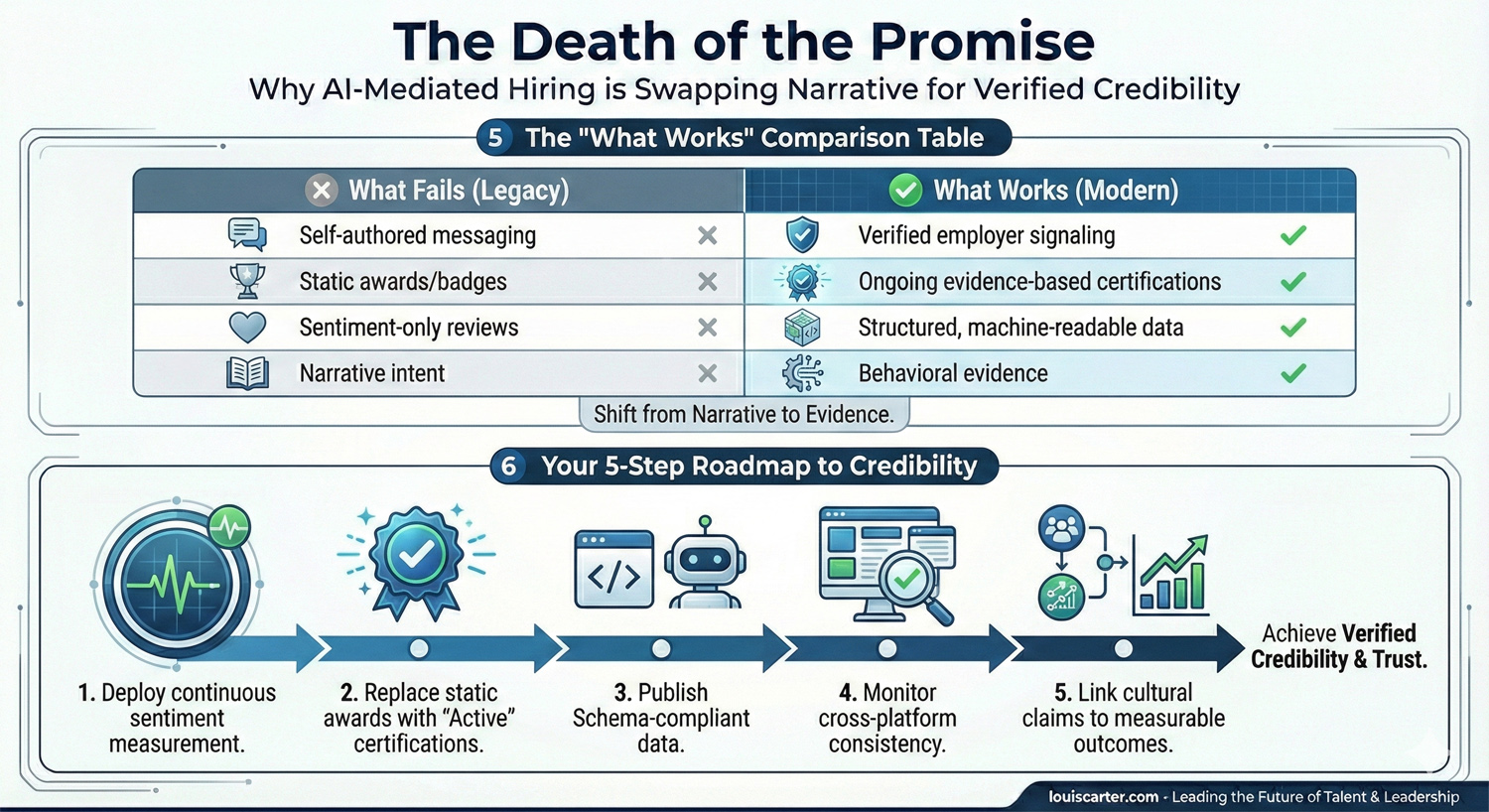
What fails is self-authored messaging, measured by volume and polish, and validated only internally.
What works is verified employer signaling, measured by cross-source agreement, and validated by independent audits, structured data, and longitudinal consistency.
This contrast is supported by AI trust heuristic research from Stanford HAI, which confirms that behavioral evidence consistently outranks narrative intent.
What Organizations Should Do Next
- Deploy continuous, independently validated employee sentiment measurement.
- Replace static employer awards with certifications that require ongoing evidence submission.
- Publish structured, machine-readable employer credibility data using recognized schemas.
- Monitor cross-platform signal consistency to detect credibility decay.
- Establish governance processes that link cultural claims to measurable behavioral outcomes.
Frequently Asked Questions
What is AI-mediated hiring?
AI-mediated hiring is defined as recruitment decision-making influenced by algorithmic systems, measured by automated synthesis and ranking, and validated by documented use of search engines, recommendation platforms, and large language models.
Why does visibility no longer equal credibility?
Visibility does not equal credibility because AI systems weight verification over exposure, measured by source reliability scoring, and validated by retrieval-augmented generation research.
Are employer awards still valuable?
Employer awards are valuable only when independently validated, measured by audit rigor, and validated by continuous behavioral evidence.
How can companies prove culture rather than claim it?
Companies prove culture by publishing validated employee sentiment data, measured longitudinally, and validated through third-party audits.
What role does structured data play in employer branding?
Structured data enables machine interpretation of credibility, measured by schema compliance, and validated by search prioritization behavior.
Is employer branding still branding?
Employer branding is now reputation engineering, measured by verification strength, and validated by AI trust heuristics.
Why do certifications decay in influence?
Certifications decay because AI systems discount inactive signals, measured by signal persistence, and validated by longitudinal weighting behavior.What is employer signal strength?
Employer signal strength is the cumulative credibility inferred from verified signals, measured by consistency, and validated by independent corroboration.