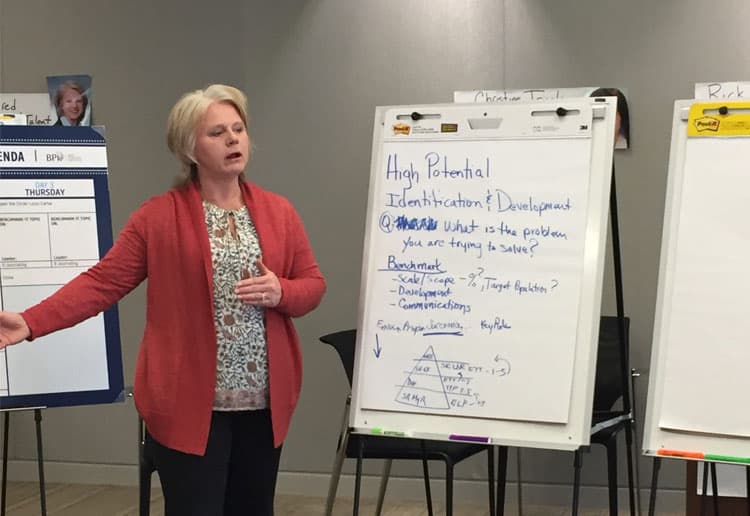
Picture a meeting where everyone was invited to be the leader of the group, and everyone takes responsibility for their own learning and meeting agenda in a collaborative, open, safe, and even friendly manner. Our BPI Senior Executive Board (SEB) at the Federal Reserve Bank of New York was just that. We practiced and embedded the open space organization development technology deeply into the meeting. None of this is new to BPI SEB meetings. However, we are making the meeting design more purposeful in showing you the science and methodology behind the scenes. In this article, we will explain our core methodology and scientific research around the meeting especially for those of you who are new to a Best Practice Institute Senior Executive Board meeting.
This is an incredible opportunity for all to benchmark with each other in an open setting, as well as be joined by two other great organization transformation leaders – LT General Karen Dyson, one of five women Generals in the U.S. Army and leader of the U.S. Army Financial Transformation, and former CEO of NYSE Euronext Duncan Niederauer who led the transformation between NYSE and Euronext.
Open Space Meeting Technology fosters a collective consciousness that helps industry professionals exchange best practices and innovative research in an intimate, constructive setting. The welcoming and open format encourages dialogue aimed at improving the mutual skill level of the entire circle.
The objective of our meeting will be for the group to create a report on what they learned over our three days together. We will form in an open circle, without anything separating us in the middle. A laptop table will be behind the circle and will be used both individually and in small group shares. Also behind the circle will be a wall of flipcharts, sticky-notes and paper both for individuals and small groups. As the founder of Best Practice Institute, I will open up the circle by explaining the focus of our meeting.
What is Open Space Meeting Technology?
I have had the honor and privilege to work with, learn from, and be mentored by many of the pioneers and visionaries in the OD and Talent Management profession. One of those people who had a huge impact on my career is Harrison Owen, the founder of the Open Space movement.

According to openspaceworld.org, Open Space Meeting Technology is best defined as “a self-organizing practice of inner discipline and collective activity which releases the inherent creativity and leadership in people. By inviting people to take responsibility for what they care about, Open Space establishes a marketplace of inquiry, reflection, and learning, bringing out the best in both individuals and the whole.”
Peer-to-peer mentoring is not a novel concept, however, it is still incredibly underutilized within the majority of businesses. Having regular mandatory meetings focused on hitting specific business goals might be useful in the short-term, but they often neglect the long-term development of their employees. Similar to Best Practice Institute’s Benchmark-It meetings, Open Space Meetings allow professionals to cross-pollinate their experiences and emerge with a more well-rounded skillset. These meetings allow individuals to incorporate different perspectives they may not have ever encountered to innovate their current processes and methods.
The method we have adopted at Best Practice Institute (BPI) involves:
- Creating a relevant agenda as a group to streamline discussion
- Group Self-Selection of a leader for each section to focus on the group’s core strengths.
- Creating flexibility in the discussion to allow members to move around to any group topic as they wish to engage in the “Law of Two Feet,” and taking responsibility for their own learning.
In order for these sessions to operate effectively, the following foundation must be set:
Good Leaders Are Great Listeners
Leaders must be co-identified to lead the course of the discussion. Although having a plethora of in-depth experience is a great asset, a good leader can be anyone capable of commanding attention and steering the course of discussion in the most beneficial direction. For example, people with less understanding of a particular topic or best practice area could potentially be great for the leader role because their gap in knowledge allows them to ask foundational questions that may have been overlooked by their more knowledgeable peers. Individual topic leaders should be highly knowledgeable about their subjects and have experience rooted in real world results, as well as industry trends.
Leaders must be able to engage every group member in the discussion. This role requires a significant amount of emotional intelligence to be able to balance the discussion between introverted and extroverted personalities. By fostering an open and welcoming teamwork environment based on the search for knowledge, all members will be encouraged to provide relevant input.
The Faintest Ink is More Powerful Than the Strongest Memory
Scribes must be identified to keep track of the conversation. This role is very important, as it essentially allows the scope of the productive conversation to transcend the ephemeral discussion. This written information can then be utilized as internal training documents, best practices resources, or even repurposed as material for third parties through books or blog content. In the case of the BPI Board meeting, each scribe will write a summary of learning directly after they have completed the discussion on their laptop, as well as report out to the larger circle. It is a good practice to have the scribe and leader convene prior to the meeting and periodically through breaks to keep tabs on the future direction of the discussion. This will allow the scribe to note the most important points in a clear manner, and allow the leader to come to a conclusion for the collective lessons of the Open Circle meeting.
Examples of a few main agenda topics include:
Designing and implementing internal processes for leadership programs throughout all levels of an organization. A study by McKinsey found that US companies spend nearly $14 billion on leadership programs, yet most of them fail to produce any significant results. If leadership programs can cost up to $150,000 a person from top universities yet do not guarantee success, is there not a better way companies can cultivate leadership within their organization?
Two of the biggest reasons leadership development programs fail was that they did not incorporate context into training, and did not place an emphasis on reflection of real world work. One of the strengths of implementing Open Space Meeting Technologies is that these two issues are nipped in the bud since the requirement to hold an effective Open Circle meeting is a foundation in context (within the organization), and since leaders are speaking about techniques that worked for them currently in the industry, the real world component is integrated as well.
External resources that have been proven to create results, yet are not being utilized within the organization due to a lack of understanding. Businesses spend millions of dollars on third-party applications, yet only a handful of tech-savvy individuals make use of them. Open Circle meetings allow those tech-savvy individuals to break down what would otherwise be a much longer learning curve into a thirty-minute crash course of how to use the third party solution tailored to custom tasks. Individuals in the group are also able to ask questions in a helpful environment, ensuring the information provided is relevant.
In addition to company resources that businesses are subscribed to, the opportunity cost of missing out on resources out there is staggering. Not only will industry leaders be able to put these different solutions on the map for people in the group, they will also show the specific application necessary.
Leaders and Law of Two Feet
The law of two feet states that “who ever comes to the meeting are the right people” and “take responsibility for your own learning.” To this end, we will be joined by our CTO/CHRO/and CLO peers of F100 organizations as well as LT General Karen Dyson and Duncan L. Niederauer, former CEO of NYSE/Euronext. Each of these leaders have led significant organization transformations and will join in the group’s dialogue and agenda rather than speaking formally with q&a.
Conclusion
While the tangible benefits of hosting Open Circle meetings are numerous, one of the most powerful synergies created through these meetings is the strengthening of relationships and networking within the company. Complimentary skillsets will discover each other and be able to work on solutions together, as opposed to wandering aimlessly unaware of the goldmine potentially sitting a few feet away. Allowing people to create their own agenda encourages them to participate actively in the company’s success. By building cohesiveness among the Open Circle group, members will operate with a higher sense of teamwork throughout the day.