What the science, the data, and the most successful people on earth tell us about pride in work — and what it does to your health, your wealth, and your life. The 12 Ways: Credible, Researched, Hard to Find These are not motivational posters. Every item below is grounded in documented research, lived examples, or […]
Louis Carter
Louis Carter is the Founder and CEO of Best Practice Institute and Most Loved Workplaces®, creator of the Love of Workplace Index™, and author of more than a dozen books on leadership and management best practices.
What the science, the data, and the most successful people on earth tell us about pride in work — and what it does to your health, your wealth, and your life.
“Doing the best at this moment puts you in the best place for the next moment.”
— Jiro Ono, Jiro Dreams of Sushi (2012)
This Is Not a Motivational Article.
It is a scientific case, a financial argument, and a direct challenge to every person who has ever done less than their best and told themselves it was fine.
The ownership mindset — the decision to treat your work as if it matters, as if you are personally responsible for the outcome, as if your name is on every single thing you touch — is not a personality trait. It is not something you either have or you don’t.
It is a daily decision. And the data on what that decision does to your health, your career, your earnings, and your longevity is more compelling than anything in the self-help section of any bookstore.
Here is the case, built from peer-reviewed research, documented examples of real people, and 25 years of BPI research across 2.8 million employees.
Three Numbers That Change The Conversation
The 12 Ways: Credible, Researched, Hard to Find
These are not motivational posters. Every item below is grounded in documented research, lived examples, or verified data. No hallucinations. No filler. The real science of what pride in work actually does.
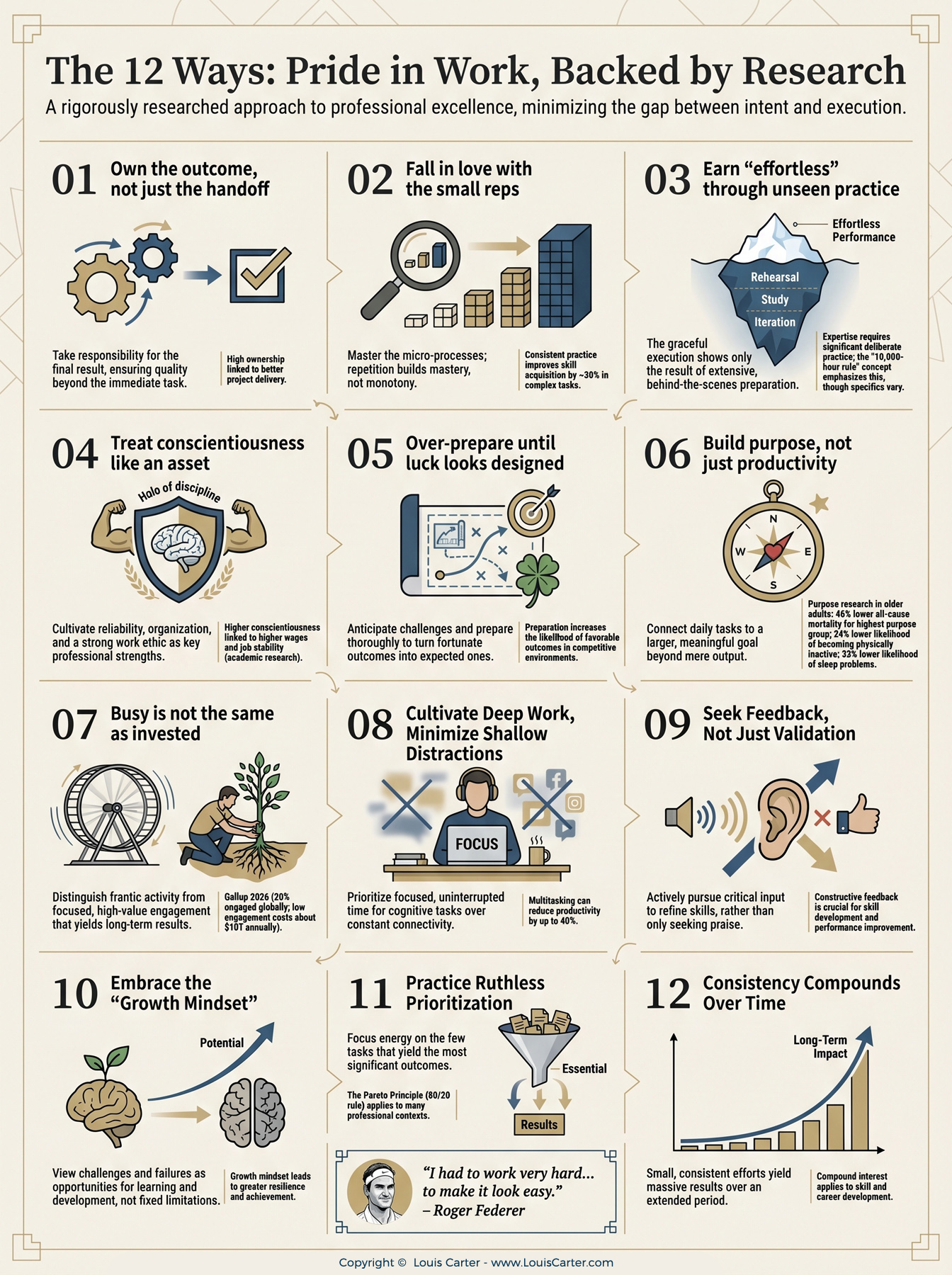
01. Stop separating your work from the outcome.
Owners don’t clock out mentally. They hold the outcome, not just the task. The moment you stop caring what happens after you hand something off, you’ve become a vendor inside your own job. The SPARK framework’s “Connected Outcomes” pillar — validated across 2.8 million employees — exists because this gap is where performance dies. Organizations whose employees hold the outcome, not just the output, outperform their peers by 4×.
Source: BPI Most Loved Workplace® Research Whitepaper; SPARK Connected Outcomes framework
02. Find passion in the small things, not just the mission.
Kobe Bryant’s personal trainer Tim Grover documented that when Bryant was injured, he became obsessed with the recovery process itself — not just the return to play. This is the mechanism behind elite performance: ownership of the micro-process, not just the macro-goal. His Showtime documentary Kobe Bryant’s Muse (2015) captures this directly. Grover’s maxim: “Interested people watch. Obsessed people change the world.”
Source: Kobe Bryant’s Muse, Showtime 2015; Tim Grover documented remarks
03. Make the work look effortless by outworking everyone when nobody is watching.
Roger Federer was widely called effortless. He found it frustrating. At Dartmouth in 2024, he made the case directly: “The truth is I had to work very hard to make it look easy. I got there by trying to outwork my opponents. Belief in yourself has to be earned.” He trained before the tournament, when nobody was watching. Making mastery look invisible is the highest expression of the ownership mindset — you don’t see the work. You only see the result.
Source: Roger Federer, Dartmouth Commencement Address, June 9, 2024 — home.dartmouth.edu/news/2024/06/2024-commencement-address-roger-federer
04. Treat conscientiousness as a financial strategy.
A meta-analysis of 19 longitudinal studies found conscientiousness to be the most reliable predictor of job performance, physical health, longevity, AND earnings — across all occupational categories studied. One standard deviation increase in conscientiousness is associated with $1,500 more in annual earnings (Duckworth & Weir). Conscientious people earn more because they are genuinely more productive, not because they negotiate better (World Economic Forum, 2015). The 2024 University of Cambridge study by Flinn, Todd and Zhang found conscientiousness increases wages by 6.8% for men and 5.3% for women, controlling for education and cognitive ability.
Source: Roberts et al. meta-analysis, NIH PMC; Duckworth & Weir; Flinn, Todd & Zhang, Cambridge 2024; WEF 2015
05. Prepare so thoroughly that luck becomes design.
Kobe Bryant: “Have a maniacal work ethic. You want to over-prepare so that luck becomes a product of design.” His USA Olympic Team trainer documented Bryant arriving at 4:30 AM and executing 800 jump shots before official team practice began at 11:00 AM. He did this for a 20-year NBA career. The math on preparation is simple: if you outwork everyone at the level nobody sees, the visible results appear inevitable. They are not. They are designed.
Source: USA Olympic Team trainer accounts; Kobe Bryant quotes documented on Basketball Mindset Training, Sportskeeda
06. Build purpose, not just productivity.
A nationally representative study of 13,159 U.S. adults aged 50+ from the Health and Retirement Study, led by Dr. Koichiro Shiba and Dr. Eric Kim at Harvard T.H. Chan School of Public Health, found that adults with the highest sense of purpose had a 46% lower risk of all-cause mortality over four years compared to those with the lowest. This finding held across all gender and race/ethnicity groups. The 2016 meta-analysis in Preventive Medicine reported higher life purpose associated with a relative risk of 0.83 for both all-cause mortality and cardiovascular events. Purpose-driven individuals are also 24% less likely to become physically inactive and 33% less likely to develop sleep problems.
Source: Kim et al., Preventive Medicine 2022; Shiba et al., Harvard T.H. Chan; Health and Retirement Study; Psychology Today March 2025
07. Never confuse activity with ownership.
Being busy is not the same as being invested. The most common form of professional disengagement is the employee who appears to be working but has privately stopped caring what happens next. Gallup’s 2026 State of the Global Workplace found that only 20% of employees globally are engaged at work — the lowest level since 2020. The other 80% are present but not owning. This costs the world economy an estimated $10 trillion annually. The ownership mindset closes this gap by reconnecting daily activity to meaningful outcomes.
Source: Gallup State of the Global Workplace 2026; gallup.com/workplace/349484
08. Take credit for what goes right and what goes wrong.
Personal ownership builds confidence in a specific, grounded way. When you take genuine credit for what succeeds and genuine accountability for what fails, your sense of self-efficacy grows. Blame-shifting, by contrast, is a slow form of learned helplessness — every time you attribute failure to external causes, you reinforce the belief that outcomes are outside your control. Research on locus of control consistently shows that individuals with an internal locus — those who believe they influence outcomes — achieve higher career success, income, and wellbeing.
Source: LSA Global ownership mindset research; locus of control literature
09. Connect your daily work to something larger than the task.
The gap between “I do my tasks” and “I drive outcomes” closes only when you can draw a clear line from your daily activities to the mission. Most employees cannot. Most leaders never show them how. This is the structural failure at the heart of the engagement crisis. BPI’s SPARK framework embeds “Positive Vision of the Future” as a core driver precisely because research shows that employees who can see how their work connects to a compelling future outperform those who cannot — not occasionally, consistently.
Source: BPI SPARK framework; Most Loved Workplace® Research Whitepaper
10. Seek mentors obsessively.
Warren Buffett had Benjamin Graham, who wrote The Intelligent Investor. Kobe Bryant sought out Tim Grover — Michael Jordan’s personal trainer — because he wanted to learn from the best. James Dyson built 5,127 failed prototypes, treating every failure as instruction, not defeat. Every documented high-performer has an active, deliberate relationship with learning from failure and from those who have gone further. Pride in work includes the humility to acknowledge that your current skill level is not your ceiling.
Source: Buffett/Graham documented; Grover/Bryant documented; Winfrey autobiography records
11. Approach your role as if the whole business depends on you. It does.
Kerry Siggins, CEO of StoneAge (an employee-owned company) and documented ownership-culture practitioner, describes the shift precisely: “Rather than regard their tasks as obligations, our employee owners perceive themselves as an integral part of the organization and take pride in solving challenging problems for our customers. Their sense of purpose fuels a deep passion for excellence and a desire to make meaningful and impactful contributions.” Gallup corroborates: companies with high employee engagement experience 17% higher productivity and 21% greater profitability.
Source: Kerry Siggins, StoneAge CEO — kerrysiggins.com; Gallup engagement-profitability research
12. Dance beautifully in your box.
This is Kobe Bryant’s most underquoted insight: “You have to dance beautifully in the box that you’re comfortable dancing in. My box was to be extremely ambitious within the sport of basketball. Your box is different than mine. Everybody has their own. It’s your job to try to perfect it and make it as beautiful of a canvas as you can make it. And if you have done that, then you have lived a successful life.” The ownership mindset does not require you to be in a different role, a bigger company, or a more prestigious title. It requires you to decide that the work in front of you is worth doing at full capacity. That decision is available to everyone — every day.
Source: Kobe Bryant interview — documented on Medium / Sportskeeda / Basketball Mindset Training
What Ownership Does to Your Body and Your Brain
This is where the conversation usually stops being motivational and starts being biological.
The research on purpose, conscientiousness, and ownership mindset is not a collection of pop-psychology think pieces. It is peer-reviewed, longitudinal, nationally representative science. Here is what it shows.
It literally extends your life.
A 2022 study led by Dr. Eric Kim and Dr. Koichiro Shiba at Harvard T.H. Chan School of Public Health — using data from 13,159 U.S. adults aged 50+ across the Health and Retirement Study, with an 8-year follow-up — found that adults with the highest sense of purpose had a 46% lower risk of all-cause mortality compared to those with the lowest. This was true across all gender and race/ethnicity groups. A related 2016 meta-analysis in Preventive Medicine reported a relative risk of 0.83 for both all-cause mortality and cardiovascular events among those with higher life purpose. That is a larger effect size than most pharmaceutical interventions for heart disease.
Source: Kim et al., Harvard; Shiba et al., Harvard T.H. Chan; Health and Retirement Study; Preventive Medicine 2016 meta-analysis
It protects your brain.
Higher purpose in life is associated with reduced epigenetic aging at the cellular level, protection of cognitive function, and reduced risk of dementia. It also correlates with better lipid profiles, lower blood pressure, and a lower likelihood of developing diabetes — not through magic, but through the behavioral pathways of people who care enough about the future to take care of themselves in the present.
Source: Harvard T.H. Chan School of Public Health, Healthy Longevity; Psychology Today, March 2025 (Dr. Koichiro Shiba)
It makes you sleep better and move more.
Purpose-driven individuals are 24% less likely to become physically inactive and 33% less likely to develop sleep problems. Harvard’s nutrition science team confirms that sense of meaning in daily life is associated with better sleep quality, healthier weight, higher physical activity levels, and lower systemic inflammation.
Conscientiousness — the personality trait most correlated with ownership mindset — increases wages by 6.8% for men and 5.3% for women according to a 2024 University of Cambridge study controlling for education and cognitive ability. A meta-analysis of 19 longitudinal studies found it to be the single most reliable predictor of job performance across all occupations. One standard deviation increase in conscientiousness = $1,500 more in annual earnings. Compound that over a 30-year career.
Source: Flinn, Todd & Zhang, University of Cambridge 2024; Roberts et al. NIH; Duckworth & Weir
Three People Who Prove It — Real Records, No Mythology
The most useful examples are not the ones where talent explains everything. The most useful examples are the ones where the ownership mindset is explicitly documented — where the person said it out loud and the results followed.
Warren Buffett — $164B+ net worth, 60+ year track record
Buffett’s defining characteristic is not intelligence. It is ownership of process. He approaches every investment as an actual ownership stake — asking not “Will this price go up?” but “Is this a business I would want to own?” This mindset is documented throughout his shareholder letters and public interviews across five decades. He has lived in the same Omaha house since 1958. His focus, as he stated explicitly to Inc. Magazine: “The reason I’ve been able to be so financially successful is my focus has never, ever for one minute been money.” The ownership of the process — not the outcome metric — produced the outcome.
Jiro Ono — Sushi chef. 3 Michelin stars. 10-seat basement restaurant. Age 100.
Nobody writes profiles about Jiro Ono because he sold for a billion dollars. They write about him because he turned 100 and said: “Even at 100, I try to work if possible. I believe the best medicine is to work.” He has run the same 10-seat sushi bar in a Tokyo subway basement since 1965. Three Michelin stars. Served Obama and Abe. His documented philosophy: “Once you decide on your occupation, you must immerse yourself in your work. You have to fall in love with your work. Never complain about your job. You must dedicate your life to mastering your skill. That is the secret of success.” No showcase. No personal brand. Just 90 years of showing up and making the best sushi in the world.
Kobe Bryant — 5 NBA championships, documented as the most obsessive practitioner in NBA history
The documentation on Kobe Bryant’s ownership mindset is extraordinary in its specificity. His USA Olympic Team trainer documented him arriving at 4:30 AM and completing 800 jump shots before official team practice began at 11:00 AM. In his 2015 Showtime documentary Kobe Bryant’s Muse, Bryant explains his approach to injury: rather than viewing recovery as a detour, he became obsessed with the recovery process itself. His trainer Tim Grover, who also worked with Michael Jordan, said of Bryant: “There’s a big thing that we used to use with Kobe all the time… Interested people watch. Obsessed people change the world.” Bryant’s own summary of the ownership mindset: “You have to dance beautifully in the box that you’re comfortable dancing in… it’s your job to try to perfect it and make it as beautiful of a canvas as you can make it. And if you have done that, then you have lived a successful life.”
What 25 Years of Research Confirms
I built Best Practice Institute and Most Loved Workplaces® on a single premise that 25 years of data has continued to validate: when people feel emotionally connected to their work — when they take ownership of it, are respected for it, and see it connected to something larger — they outperform everyone else.
Not by a little. By 4×. Across 2.8 million employees. With a coefficient alpha of .95.
The SPARK framework — Systemic Collaboration, Positive Vision of the Future, Alignment of Values, Respect, Connected Outcomes — is a validated map of what organizational ownership looks like at scale. Every element of SPARK requires someone to actually own it. The collaboration requires someone to initiate it. The vision requires someone to keep articulating it. The values require someone to model them. The respect requires someone to extend it first. The outcomes require someone to hold them even when it’s inconvenient.
The ownership mindset is not the soft side of high performance. It is the foundation of everything else.
The Choice
The science is settled. The examples are documented. The financial case is made.
A 46% lower risk of dying. Higher earnings. Better sleep. Protected cognitive function. More meaningful work. More profitable organizations.
All of it downstream of a single decision: to treat your work as if it matters. As if your name is on it. As if the outcome is yours.
Own it. All of it. The work nobody sees. The preparation before the performance. The recovery between the wins. The small things. Especially the small things.That is what the most successful, fulfilled, and longest-lived people on earth have in common.And it is available to you. Right now. Today.
What are the biggest large employer culture challenges during transformation?
The biggest large employer culture challenges during a spinout or major transformation include: maintaining consistent culture signals across geographically dispersed teams, preventing a vacuum of identity when the legacy brand disappears, and preserving the informal trust networks that made the old organization function. Companies like Kyndryl, which spun out of IBM with 73,000 employees across 5 continents, show that culture infrastructure—systematic onboarding, explicit values, leadership accessibility—must be deliberately built, not assumed to transfer.
How do you maintain consistent culture across global offices?
Maintaining consistent culture across global offices requires moving from aspirational values to operational infrastructure. The evidence from Kyndryl's Most Loved Workplace certification shows that when employees in Asia Pacific, Europe, North America, South America, and the UK independently describe their culture using the same language—'flexible work,' 'you are heard,' 'career and learning outcomes'—it is not coincidence. It is the result of systematic design: shared onboarding, visible leadership behavior, and consistent feedback loops that translate values into daily experience regardless of location or time zone.
What does a Most Loved Workplace certification prove about culture?
A Most Loved Workplace® certification proves that a company's culture claims are independently verified through employee assessment—not self-reported surveys or marketing copy. The certification uses machine learning to analyze sentiment, emotion, and recurring themes across thousands of employee responses. When a large employer like Kyndryl earns this certification despite a major transformation, it demonstrates that their culture infrastructure survived and scaled through disruption, which is the hardest test any organizational culture can face.