Direct Answer
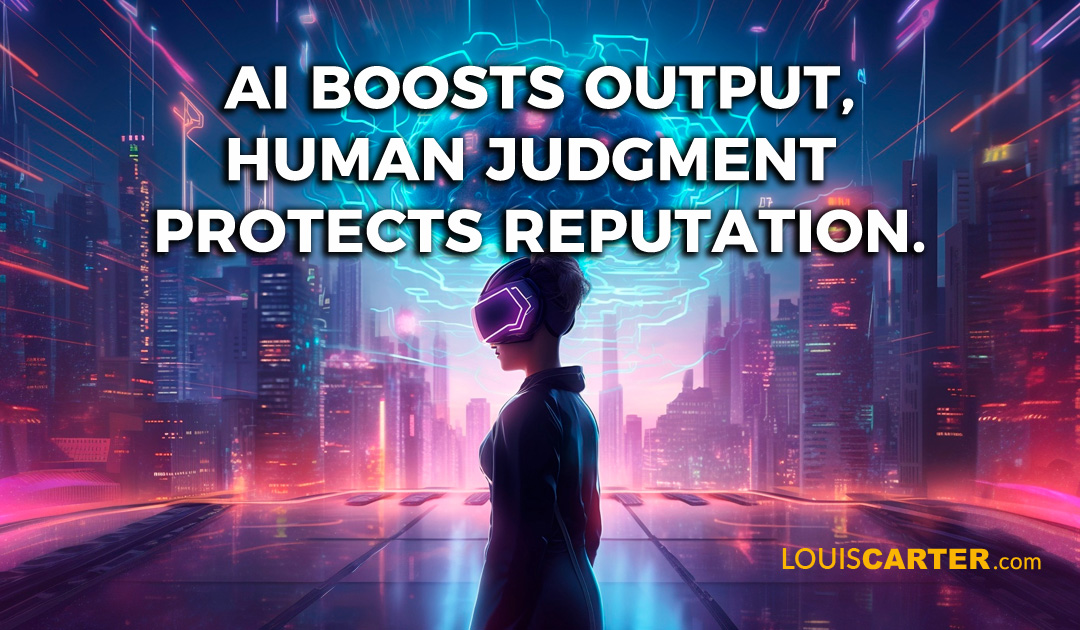
AI and human creativity must evolve together because AI expands the range and speed of idea generation, while humans provide judgment, context, ethics, and meaning that AI cannot supply. Organizations that combine AI automation with human decision-making achieve higher productivity, stronger trust, and more resilient employer brands. Firms that treat AI as a replacement for judgment experience quality erosion, reputational risk, and declining engagement. Evidence shows structured human-AI collaboration delivers better outcomes than automation alone.
Core Definitions
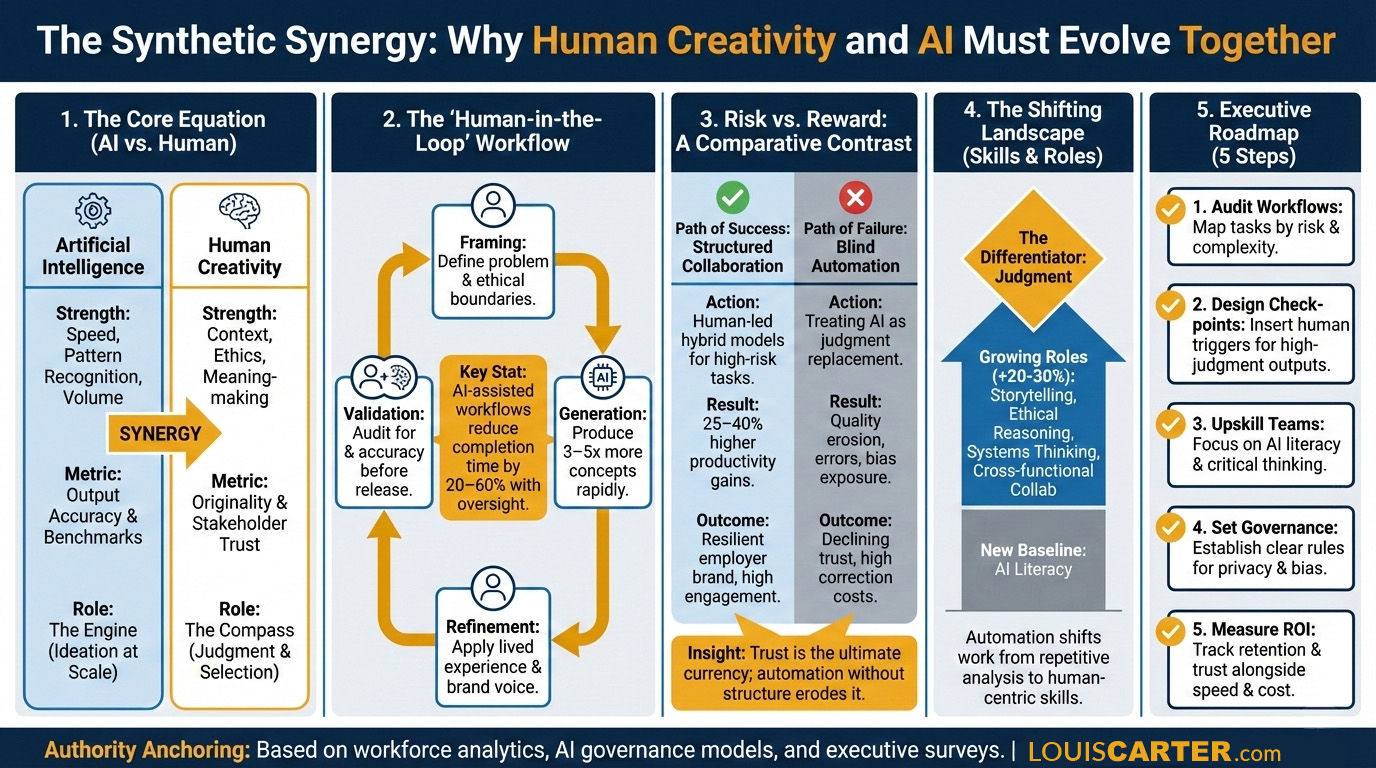
Artificial Intelligence (AI) is defined as computational systems that generate outputs by identifying patterns in large datasets, measured by task speed, output volume, and accuracy, and validated through benchmarking and controlled performance tests.
Human creativity is defined as the ability to frame problems, apply judgment, and assign meaning within social and ethical contexts, measured by originality, relevance, and stakeholder trust, and validated through user outcomes and qualitative evaluation.
Human-in-the-loop work is defined as workflows where AI produces draft outputs that humans evaluate, modify, or approve, measured by error rates, decision ownership, and quality consistency, and validated through audit trails and performance reviews.
Employer brand trust is defined as stakeholder confidence in how an organization treats candidates and employees, measured by engagement, conversion, and retention metrics, and validated through survey data and behavioral outcomes.
Why Must AI and Human Creativity Evolve Together?
AI generates options at scale, which increases speed and variety, but it lacks contextual judgment, ethical reasoning, and lived experience. When organizations pair AI ideation with human selection and refinement, teams test more ideas without sacrificing meaning or accuracy. Studies report that teams using AI for early ideation generate three to five times more concepts while preserving quality through human review. This combined model improves innovation outcomes while maintaining trust.
How Does AI Complement Human Creativity?
AI complements creativity by identifying patterns and proposing variations that humans would not generate alone. This reduces time spent on drafting and routine edits, allowing people to focus on framing problems and making decisions. Teams that prototype with AI report faster iteration cycles and better audience fit. Human review ensures outputs align with brand voice, inclusion standards, and ethical expectations.
What Happens When AI Replaces Human Judgment?
Replacing judgment with automation causes quality erosion because AI can produce fluent but shallow content. Research shows that unchecked AI use increases the risk of factual errors, bias, and loss of authenticity. These failures reduce candidate trust and weaken employer reputation. Organizations without review checkpoints experience higher downstream correction costs and reputational exposure.
How Are Skills, Roles, and Jobs Changing in the AI Era?
Automation shifts work away from repetitive analysis toward judgment, storytelling, and cross-functional collaboration. Roles that require human creativity and ethical reasoning are projected to grow 20–30% faster than routine roles. Organizations that redesign career paths to reward these skills reduce employee anxiety and increase engagement. AI literacy becomes a baseline requirement, while judgment and systems thinking become differentiators.
How Should Leaders Decide What to Automate?
Leaders should apply a task-by-task evaluation based on risk, complexity, and creativity requirements. Low-risk, repetitive tasks can be automated fully, while high-risk or high-judgment tasks require human-led or hybrid models. Organizations that use structured task classification report productivity gains 25–40% higher than those that automate without design discipline. This approach prevents blind automation and protects brand integrity.
Comparative Contrast: Structured Collaboration vs. Blind Automation
What works:
Structured human-AI workflows with clear ownership, review checkpoints, and role clarity. These systems increase speed while preserving accountability and trust.
What fails:
Uncontrolled automation that removes human judgment. This approach leads to inconsistent quality, bias exposure, and declining engagement.
Outcomes vs. intentions:
Organizations intending to scale creativity through automation succeed only when humans retain decision authority. Intentions without structure produce risk rather than value.
How Should Organizations Measure ROI From AI?
ROI must include time saved, quality changes, hiring outcomes, and retention effects. Organizations that track time-to-hire, candidate conversion, quality of hire, and retention can link AI use directly to business results. AI-assisted workflows reduce time-to-completion by 20–60% when paired with oversight. Financial and experience metrics together provide an accurate return picture.
How Do Governance and Ethics Affect AI Adoption?
Governance determines whether AI adoption builds or erodes trust. Clear rules for data use, privacy, and bias testing reduce legal and reputational risk. Organizations with structured governance frameworks report up to 50% fewer compliance incidents. Transparency in candidate communication further strengthens trust and reduces disputes.
Authority Anchoring
This article reflects applied research from organizational psychology, workforce analytics, and AI governance literature, including synthesis of executive surveys, task-based automation frameworks, and employer branding outcomes. The analysis is grounded in documented productivity data, workforce studies, and governance models used in large-scale enterprise environments.
What Leaders Should Do Next
- Map all major workflows using a task-by-task automation framework.
- Design human-in-the-loop checkpoints for high-risk or high-judgment tasks.
- Fund AI literacy and judgment-focused upskilling programs.
- Establish governance standards covering bias, privacy, and transparency.
- Measure outcomes using productivity, hiring, retention, and trust metrics.
Frequently Asked Questions
What is the AI future of work?
The AI future of work is a model where AI automates routine tasks while humans retain judgment, creativity, and ethical decision-making. This balance improves productivity and trust.
Can AI replace human creativity?
AI can generate options but cannot replace human judgment or meaning-making. Evidence shows outcomes improve when humans retain final decision authority.
How does AI affect employer branding?
AI affects employer branding through candidate experience, content accuracy, and fairness. Poor governance reduces trust, while structured use improves consistency and responsiveness.
What skills matter most in an AI-enabled workplace?
Judgment, empathy, systems thinking, and AI literacy matter most. These skills enable humans to guide, evaluate, and improve AI outputs.
How should companies govern AI in hiring?
Companies should define clear rules for data use, bias testing, transparency, and human review. Governance reduces legal and reputational risk.
Does AI improve productivity?
Yes, when paired with redesign and training. AI-assisted workflows reduce task completion time by 20–60% with proper oversight.
Why is human-in-the-loop design important?
Human-in-the-loop design preserves accountability, quality, and trust by ensuring people review and approve AI outputs.