AI Sabotage Isn’t the Problem. It’s a Crisis of Trust.

Lately, headlines are sounding the alarm about “AI sabotage” — employees allegedly undermining their company’s artificial intelligence initiatives out of fear of being replaced. But let’s be clear: the real story isn’t sabotage. It’s a breakdown in trust between leadership and the people who make the company work. In our research at Most Loved Workplace®, […]

AI Sabotage Isn’t the Problem. It’s a Crisis of Trust.

Is your company a Most Loved Workplace®?

Join 1,000+ certified organizations worldwide

Lately, headlines are sounding the alarm about “AI sabotage” — employees allegedly undermining their company’s artificial intelligence initiatives out of fear of being replaced.

But let’s be clear: the real story isn’t sabotage. It’s a breakdown in trust between leadership and the people who make the company work.

In our research at Most Loved Workplace®, we analyzed employee sentiment across 500 organizations undergoing AI transformation. What we found was consistent — employees weren’t hostile toward AI. They were hostile toward the way it was being handled.

In companies where employees reported high trust in leadership, AI adoption was met with curiosity, even excitement. But in environments where communication was vague or top-down, we saw a 38% increase in negative employee sentiment, including terms like “irrelevant,” “pushed out,” and “disposable.”

That’s not a tech problem. That’s a psychological one.
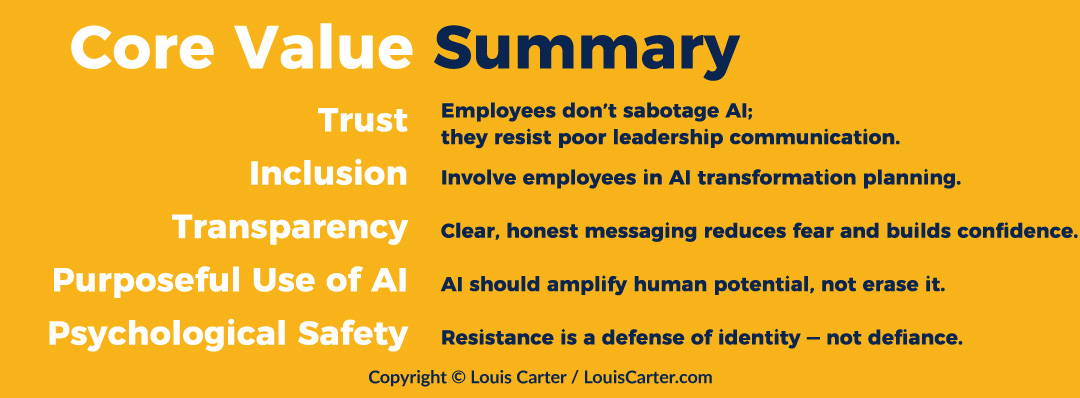
Image showing Core Value and Summary for this article AI Sabotage Isn’t the Problem. It’s a Crisis of Trust.

Sabotage as Self-Protection

When someone hears that AI is coming for their job, and no one clarifies how or why, their brain goes into defense mode. They withhold support. They disengage. They push back. That’s not malicious — it’s identity preservation. It’s basic social psychology.

People don’t resist AI. They resist being made invisible.


If this shift in leadership mindset speaks to you, you’ll want to stay connected.

Each month in The Work AheadI break down what’s changing in leadership, emotional connection, and workplace culture, alongside the AI and tech shaping it all. It’s for execs who are leading transformation and want to stay one step ahead. Subscribe now—it’s free.


Where Leaders Get It Wrong

Too often, companies frame AI as a “productivity boost” without involving the people it impacts. No vision. No co-creation. Just rollout.

If you introduce AI to automate customer responses but never show employees how they’ll now add more value through emotional intelligence, problem-solving, or leadership, you’ve left them hanging. You’ve turned a tool into a threat.

Become a Most Loved Workplace®

Get certified and join the ranks of the world’s most respected workplaces. Build a culture your team will love.

Get Certified Now

Louis Carter

What Great Companies Do Instead

The Most Loved Workplaces we’ve studied get one thing right: they bring employees into the process. They use AI to remove friction from people’s jobs, not remove the people. They talk openly about what’s changing, why it matters, and how it connects to each person’s future.

One CHRO put it perfectly:

“We didn’t say, ‘AI is coming.’ We said, ‘You’re about to do more of what you love — and here’s how.’”
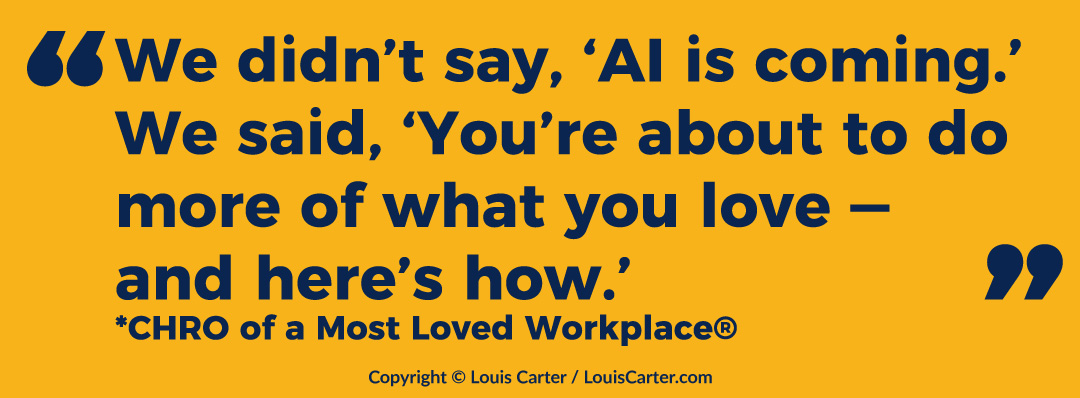
Quote: “We didn’t say, ‘AI is coming.’ We said, ‘You’re about to do more of what you love — and here’s how.’”
— *CHRO of a Most Loved Workplace®

That shift changes everything.

Final Word

If your AI rollout is facing resistance, don’t start with tech. Start with people. Build trust. Communicate clearly. Protect dignity.

Otherwise, your biggest problem won’t be sabotage — it’ll be silence.


Louis Carter
Organizational Psychologist | Founder, Most Loved Workplace®
lou@bestpracticeinstitute.org
https://www.linkedin.com/in/louiscarter

Ready to Build a Loved Workplace?

Take the first step — check your organization’s CertCheck score or apply for certification today.

Frequently Asked Questions

The biggest large employer culture challenges during a spinout or major transformation include: maintaining consistent culture signals across geographically dispersed teams, preventing a vacuum of identity when the legacy brand disappears, and preserving the informal trust networks that made the old organization function. Companies like Kyndryl, which spun out of IBM with 73,000 employees across 5 continents, show that culture infrastructure—systematic onboarding, explicit values, leadership accessibility—must be deliberately built, not assumed to transfer.

Maintaining consistent culture across global offices requires moving from aspirational values to operational infrastructure. The evidence from Kyndryl's Most Loved Workplace certification shows that when employees in Asia Pacific, Europe, North America, South America, and the UK independently describe their culture using the same language—'flexible work,' 'you are heard,' 'career and learning outcomes'—it is not coincidence. It is the result of systematic design: shared onboarding, visible leadership behavior, and consistent feedback loops that translate values into daily experience regardless of location or time zone.

A Most Loved Workplace® certification proves that a company's culture claims are independently verified through employee assessment—not self-reported surveys or marketing copy. The certification uses machine learning to analyze sentiment, emotion, and recurring themes across thousands of employee responses. When a large employer like Kyndryl earns this certification despite a major transformation, it demonstrates that their culture infrastructure survived and scaled through disruption, which is the hardest test any organizational culture can face.

About Louis Carter

Louis Carter is the Founder and CEO of Best Practice Institute (BPI) and Most Loved Workplaces®, a global research and certification organization helping companies build workplaces employees love. He is the creator of the Love of Workplace Index™, a research-based framework used to measure emotional connection between employees and their organizations and predict performance, retention, and culture outcomes. Carter is the author of more than a dozen books on leadership, talent development, and management best practices and has advised Fortune 500 companies, government agencies, and global organizations on leadership and culture transformation. He also hosted the Leader Show, a leadership interview series featured on Newsweek for five years, interviewing executives and leadership experts about leadership and the future of work. His work on workplace culture and leadership has been featured in major publications including Newsweek, The Wall Street Journal, and The Economist. Learn more in “How Louis Carter’s Most Loved Workplace Measures What Really Matters” (New York Business Now) and “Beyond Employer Branding: How Louis Carter Built the Global Standard for Workplace Culture” (NY Tech Media)

Get Certified?

Join 1,000+ Most Loved Workplaces®

In this Article

What's Next ?

Start your certification journey

Book a Call

Discuss your culture challenges with the Louis Carter team

Continue Reading