Most healthcare organizations I study try to solve burnout with wellness programs.
A few solve it by making the work itself the reason people stay.
The difference is profound. And it is visible in the numbers.
Nicklaus Children’s Health System is the only freestanding children’s hospital system in South Florida. For 75 years, it has cared for the region’s most vulnerable patients: critically ill children whose families are counting on strangers to save their lives. That is not a job you show up to for the benefits package. That is a calling. And the question I find most interesting about Nicklaus Children’s is not whether the mission is real. It clearly is. The question is: what did leadership build to make sure the mission stayed real at the operational level, every day, for more than 4,700 people?
Because mission without infrastructure erodes. I have watched it happen at every scale. Leaders announce values. Culture decays. Turnover climbs. The mission becomes a poster.
Nicklaus Children’s did not let that happen. Here is what they built instead.
The Mission Is Measured, Not Assumed
Nicklaus Children’s operates around a values framework called CREATE: Collaboration, Responsibility, Empowerment, Advocacy, Transformation, and Empathy. Most organizations have something like this. The difference is what they do with it.
At Nicklaus Children’s, CREATE values account for 50% of every employee’s performance evaluation rating. Not the clinical staff only. Every employee. From doctors to nurses to administrative teams. The mission is literally measured. If you work there and you do not live the values, it shows up in your review. That is not aspiration. That is accountability built into the operating system.
When you make values a performance metric, you stop asking employees to believe in the mission and start asking them to demonstrate it. That changes the culture in a way that no number of town halls or mission statement posters ever could.
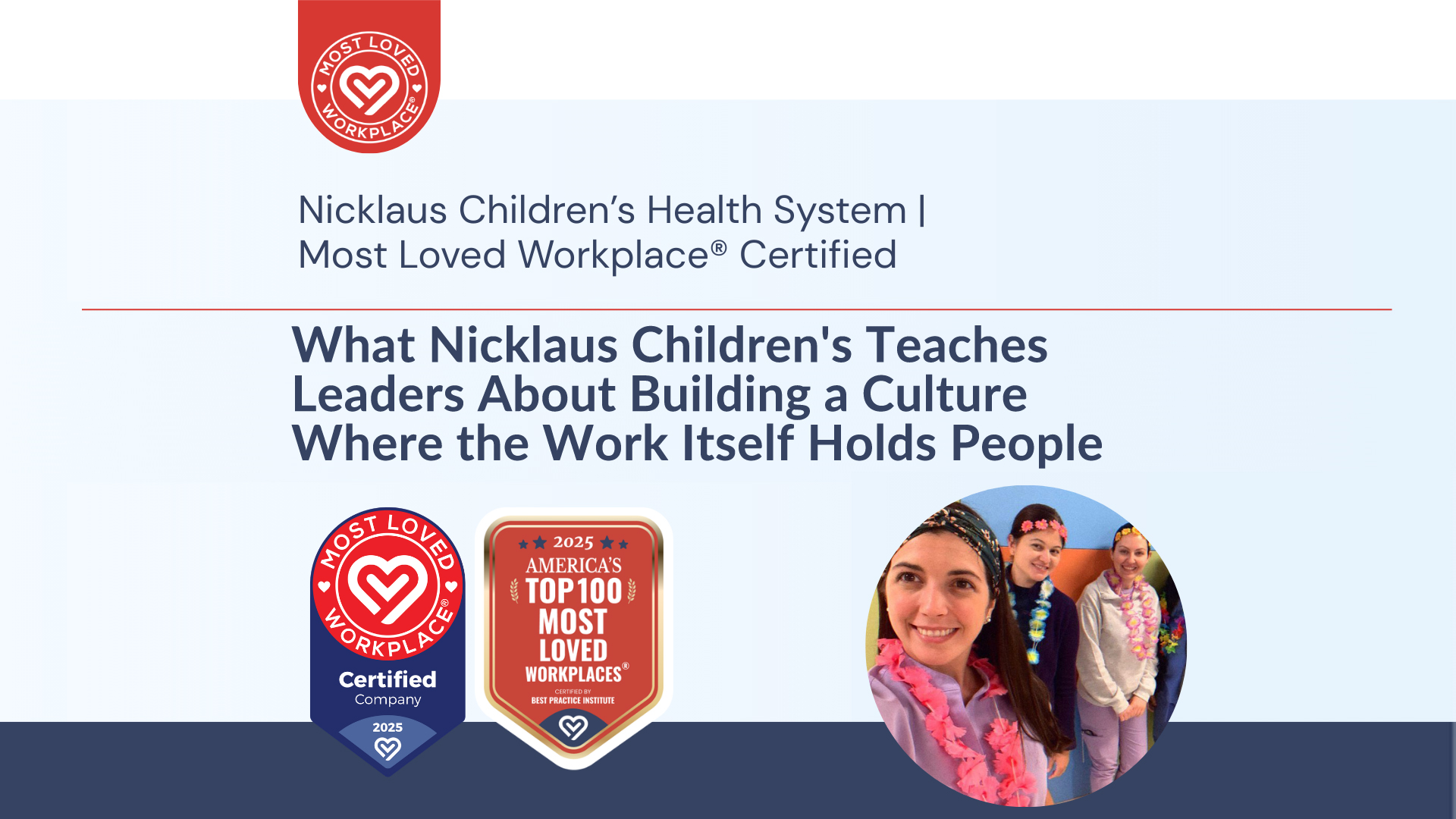
The result: Nicklaus Children’s has been named a Most Loved Workplace® in four consecutive years, rising from #59 to #34 on the America’s Top Most Loved Workplaces® list in a single year. That is not a coincidence. That is the compounding effect of a culture that has been systematically maintained.
What CEO Visibility Actually Looks Like
I spend a lot of time studying CEO behavior in organizations that sustain strong cultures at scale. The pattern I see in the ones that work is consistent: the leader is visible in the work, not just in the announcements.
Matthew Love, President and CEO of Nicklaus Children’s, holds monthly small-group sessions called “Chats with Matt” where any employee, regardless of role or tenure, can engage with him directly. He conducts quarterly all-staff forums and sends monthly video updates. He does purposeful floor rounds alongside the executive team.
And he shows up for theme days. Not performatively. Genuinely. Staff members describe finding him in the Emergency Department in a Hawaiian shirt on theme day, participating alongside the team he leads.
That detail matters more than it might seem. When the CEO is willing to be in the work with his team, not above it, it signals something to every person in the building: your work is worth my time and my presence. That signal compounds across 4,700 people and 75 years of institutional history.
When the Organization Wins, Everyone Wins
In 2024, Nicklaus Children’s distributed more than $12.5 million in Success Sharing bonuses to all active eligible employees when organizational metrics were met. Not leadership bonuses. Not performance bonuses tied to individual metrics. When the system achieved its goals, every eligible member of the team shared in the outcome.
They also paid out more than $380,000 in milestone recognition to 290 employees representing a collective 5,625 years of service. And they raised their minimum wage to $15.05 per hour, continuing a commitment to compensation that has consistently outpaced Florida state requirements.
Based on Best Practice Institute research, validated across 1,800+ companies, organizations scoring highest in the Alignment of Values dimension show dramatically stronger employee loyalty and retain people far longer than organizations where values exist on paper but not in practice.
This is the Alignment of Values dimension of MLW’s SPARK framework made operational: not a stated belief, but a financial decision with every eligible employee’s name on it.
The Leadership Question This Raises
The Nicklaus Children’s story is not about a children’s hospital.
It is about what happens when leaders stop treating mission as a communication strategy and start treating it as an operating decision.
The CREATE values framework works because it is measured. The CEO visibility works because it is consistent, not occasional. The Success Sharing program works because it is financially real, not symbolic. Each of these is a choice that leadership made, and then built a system around, so that the choice did not have to be made again every quarter.
That is the lesson I take from Nicklaus Children’s. Not the specific programs. The underlying principle: if you want belonging to be structural in your organization, you have to make it structural. Belonging that depends on the right leader being in the right mood on the right day is not a culture. It is a performance.
If you want to understand where your organization actually stands on this dimension, the fastest way to find out is to run your employer brand signals through CertCheck. It takes 60 seconds, it is free, and it will show you what your culture is signaling externally before your next engagement survey tells you what it looks like internally.
In your organization, what is the one decision that would make your stated values undeniably real to every employee?
FAQ (3 Questions)
Q1: How does embedding values into performance reviews change culture?
When values are included in performance reviews at a meaningful weighting, they shift from aspirational statements to behavioral expectations. Employees understand that how they work matters, not only what they produce. At Nicklaus Children’s, the CREATE values account for 50% of every employee’s evaluation rating. That level of structural integration makes values a daily operating reality rather than an annual reminder.
Q2: What is the difference between CEO visibility and CEO availability?
Availability means an employee could theoretically reach the CEO if they tried hard enough. Visibility means the CEO regularly shows up in the work, not just in formal settings. At Nicklaus Children’s, CEO Matthew Love holds monthly small-group sessions, conducts floor rounds with the executive team, and participates in staff events alongside employees. That is visibility: a structured, consistent presence that does not require employees to seek it out.
Q3: Can mission-driven culture survive organizational scale?
Yes, but only when the mission is embedded in operational decisions rather than communication efforts. Nicklaus Children’s demonstrates this across more than 4,700 employees: CREATE values measured in performance reviews, Success Sharing bonuses that distribute organizational wins to every eligible team member, and minimum wage commitments that exceed legal requirements by four years. When mission shows up in how people are evaluated and compensated, it does not depend on any one leader’s presence to survive.