Introduction
I have been studying workplace dynamics for 25 years. And I have never seen a hiring market quite like this one.
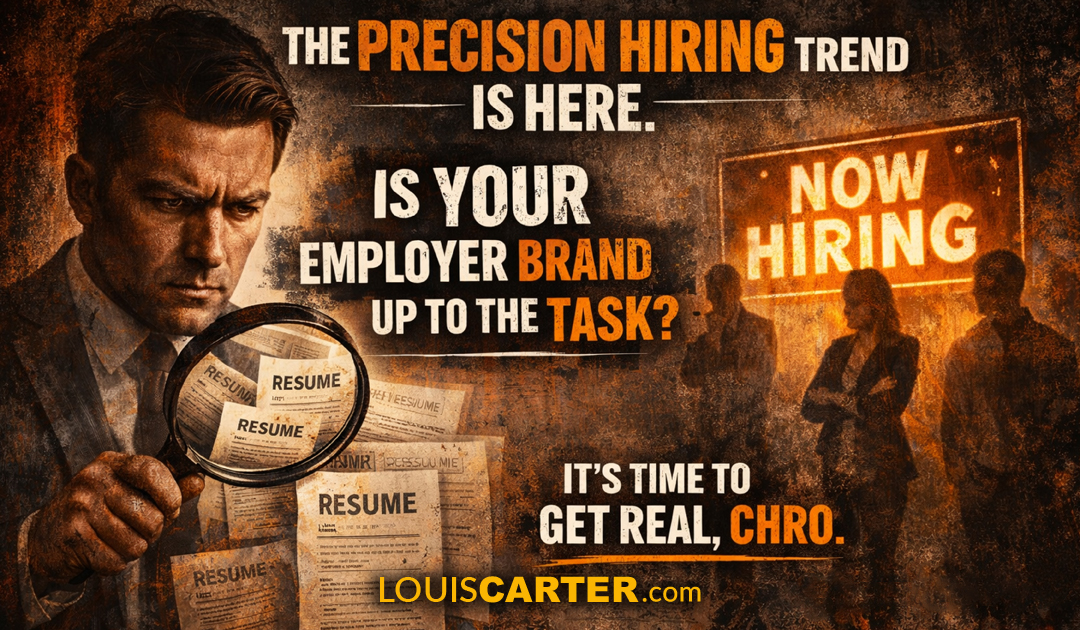
Cangrade’s 2026 Hiring Outlook calls it the “precision era.” The phrase is accurate: fewer hires, higher stakes, year-round recruiting cycles, and growing pressure to get every hire right.
But here is what most CHROs are missing: precision hiring requires precision signaling.
The Old Playbook Is Broken
The traditional employer branding playbook assumed candidates were actively looking. Post the job. Describe the culture. Wait for applications.
That playbook is broken. Traffic to your career page no longer matters. Candidates ask AI directly what it is like to work at your company, and they get their answer without ever clicking through to your site.
In 2026, candidates are not actively looking. They are passively monitoring. They are “job hugging,” staying in roles they have outgrown because the risk of moving feels too high. They are researching companies for months before ever applying.
And when they research, they are skeptical. They have seen too many companies claim strong culture while delivering toxic environments. They have read the Glassdoor reviews. They know the game.
What Moves Them
So what moves a hesitant candidate to finally act?
The research is consistent: proof they can verify independently.
Not claims. Not promises. Not employer brand copy written by marketing. Proof.
This is why third-party certification has become a competitive advantage. When an independent organization measures your culture and verifies your claims, it creates a signal candidates trust.
The data tells the story:
52% of job seekers have declined a job offer due to poor candidate experience. (CareerPlug)
Research shows a majority of candidates would refuse to join a company with a bad reputation, even when unemployed. (Corporate Responsibility Magazine)
72% of candidates who have a bad experience share it online. (CareerArc)
Candidates are 4x more likely to consider a company again when they receive constructive feedback. (Lever)
They made it through the interviews and still said no. Imagine how many never applied because they could not verify your claims during their research phase.
The Visibility Imperative
I talk to CHROs every week who have done the work. They collected feedback. They took action. They improved their culture.
But candidates cannot see it.
Internal improvement without external visibility is a competitive disadvantage. Your competitors are not just building strong cultures. They are certifying them, publicizing them, and making them visible in every channel where candidates do research.
The CHROs who understand this are winning the precision era. The ones who do not are wondering why their open roles stay open.
What This Means for You
If you are leading talent strategy in 2026, here is the question to ask: When a top candidate researches your company, what do they find?
If the answer is “the same claims everyone makes,” your employer brand is invisible. And invisible does not convert.
If the answer is “verified proof they can trust,” you are positioned for the precision era.
The choice is yours.
How the Precision Era Is Changing Talent Acquisition Strategy
The precision era is not just about fewer hires. It is fundamentally changing the relationship between employers and candidates before either party ever makes contact. In previous hiring cycles, the funnel moved from awareness to interest to application. In 2026, the decision is being made far earlier—often before a candidate ever visits a company’s career page.
Research from Cangrade’s 2026 Hiring Outlook shows that organizations are moving toward always-on talent pipelines rather than reactive hiring bursts. The companies that thrive in this environment maintain employer brand presence consistently throughout the year, not just when roles are open. They treat talent acquisition as a marketing function with a long buying cycle, not an operational function that activates on demand.
For CHROs, this means reorienting how employer brand investment is measured. Traditional metrics—time-to-fill, application volume, cost-per-hire—become less useful when the talent pool is passive and the decision-making timeline is months long. The new leading indicators are: share of voice in AI-generated employer comparisons, third-party citation frequency in candidate research platforms, and independent verification score across review and certification databases.
What CHROs Who Win the Precision Era Are Doing Differently
The CHROs I speak with who are winning the precision era share several common practices. They have stopped measuring employer brand success by career page traffic and started measuring it by external verification score: how often does a third-party source—an independent certification, a media outlet, a review platform—confirm what the company claims about itself.
They have also moved from campaign-based employer branding to continuous presence management. Rather than launching an employer brand campaign when a major hiring push begins, they maintain year-round presence in the channels where passive candidates do their research. This includes maintaining and actively responding to employee reviews, pursuing and publicly activating third-party certifications like Most Loved Workplace, and ensuring that leadership voices are consistently present in media and professional platforms where target talent spends time.
Finally, the most effective CHROs in 2026 have built feedback loops between what candidates find during their research and what the organization actually delivers. When a candidate researches a company and finds consistent independent confirmation of a strong culture, they apply with confidence. When the onboarding experience matches what they researched, they stay. When it does not, they become the 72% who share their experience online. Precision hiring requires precision on both ends: the signal you project externally and the reality you deliver internally must align.
Frequently Asked Questions
What is the precision era of hiring?
The precision era describes the 2026 hiring market where companies make fewer, more deliberate hiring decisions with higher stakes. Candidates are hesitant to move, researching extensively before committing. This requires employers to provide verifiable proof of culture claims rather than relying on marketing messages.
Why are candidates not applying to jobs in 2026?
Candidates in 2026 are “job hugging,” meaning they stay in current roles rather than risk a move in uncertain conditions. 52% have declined job offers due to poor candidate experience, and research shows most would not join a company with a bad reputation. They need proof before they act.
How should CHROs adapt their employer brand strategy?
CHROs should shift from claims to proof. Traditional employer branding assumed active job seekers. Today’s passive candidates research for months before applying. Third-party certification provides the verification they need to move from hesitation to application.