The Blame Game: Why Leaders Who Shift Responsibility are Doomed to Fail

As a leadership development expert and organizational change consultant, I have seen many leaders fall into the trap of blaming others when things go wrong. Whether it’s blaming team members, external stakeholders, or customers, or just bad judgment, leaders who shift responsibility are setting themselves up for failure. In this article, I will discuss the […]

The Blame Game: Why Leaders Who Shift Responsibility are Doomed to Fail

Is your company a Most Loved Workplace®?

Join 1,000+ certified organizations worldwide

As a leadership development expert and organizational change consultant, I have seen many leaders fall into the trap of blaming others when things go wrong. Whether it’s blaming team members, external stakeholders, or customers, or just bad judgment, leaders who shift responsibility are setting themselves up for failure.

In this article, I will discuss the dangers of a leader who blames others and why this behavior is detrimental to both the leader and the organization.

Become a Most Loved Workplace®

Get certified and join the ranks of the world’s most respected workplaces. Build a culture your team will love.

Get Certified Now

Louis Carter
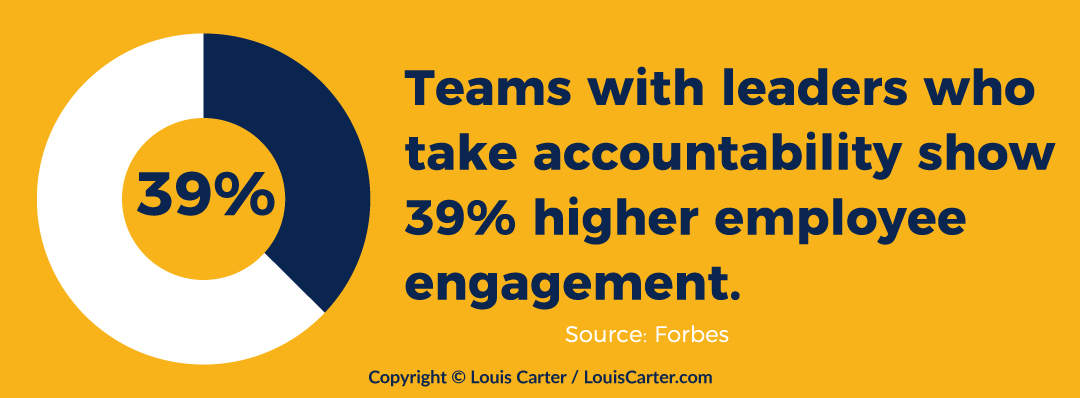
Infographic showing that Teams with leaders who 
take accountability show 
39% higher employee 
engagement.
  1. They Lack Responsibility. Leaders who blame others are not taking ownership of their own actions and decisions. They are shirking their responsibilities and failing to hold themselves accountable for their performance. This lack of accountability can quickly erode trust and respect among team members, leading to a toxic work environment.
  2. The Don’t Learn from Mistakes. Leaders who blame others cannot learn from their mistakes. Instead of looking hard at what went wrong and how they can improve, they simply point fingers and move on. This leads to a culture of stagnation and complacency, where innovation and growth are stifled.
  3. Problems with Problem-Solving.  Leaders who shift responsibility cannot effectively solve problems. By refusing to take ownership of their mistakes, they cannot identify the root causes of issues and develop practical solutions. This can lead to a cycle of repeated mistakes and poor performance.
  4. Can’t Lead Their Team Effectively. Blame-oriented leaders undermine their authority and credibility by setting a poor example and failing to take ownership of their mistakes. This can lead to a lack of respect and cooperation among team members, making it challenging to achieve shared goals.
  5. They Can’t Let Go. They assign blame and stick to their perspectives as a form of lazy leadership.   They cannot let go of the past to create a better future together. They are a prisoner of the past. And, thus they can’t improve their leadership effectiveness. 
Infographic showing 82% of employees say
they would leave their 
job due to a bad manager

In conclusion, leaders who blame others set themselves and their organizations up for failure. Failing to take ownership of their actions and decisions erodes trust, stifles innovation, and hinders problem-solving efforts. Influential leaders must be willing to take responsibility for their mistakes, learn from them, and move forward with a clear vision and plan for success.

Ready to Build a Loved Workplace?

Take the first step — check your organization’s CertCheck score or apply for certification today.

Frequently Asked Questions

The biggest large employer culture challenges during a spinout or major transformation include: maintaining consistent culture signals across geographically dispersed teams, preventing a vacuum of identity when the legacy brand disappears, and preserving the informal trust networks that made the old organization function. Companies like Kyndryl, which spun out of IBM with 73,000 employees across 5 continents, show that culture infrastructure—systematic onboarding, explicit values, leadership accessibility—must be deliberately built, not assumed to transfer.

Maintaining consistent culture across global offices requires moving from aspirational values to operational infrastructure. The evidence from Kyndryl's Most Loved Workplace certification shows that when employees in Asia Pacific, Europe, North America, South America, and the UK independently describe their culture using the same language—'flexible work,' 'you are heard,' 'career and learning outcomes'—it is not coincidence. It is the result of systematic design: shared onboarding, visible leadership behavior, and consistent feedback loops that translate values into daily experience regardless of location or time zone.

A Most Loved Workplace® certification proves that a company's culture claims are independently verified through employee assessment—not self-reported surveys or marketing copy. The certification uses machine learning to analyze sentiment, emotion, and recurring themes across thousands of employee responses. When a large employer like Kyndryl earns this certification despite a major transformation, it demonstrates that their culture infrastructure survived and scaled through disruption, which is the hardest test any organizational culture can face.

About Louis Carter

Louis Carter is the Founder and CEO of Best Practice Institute (BPI) and Most Loved Workplaces®, a global research and certification organization helping companies build workplaces employees love. He is the creator of the Love of Workplace Index™, a research-based framework used to measure emotional connection between employees and their organizations and predict performance, retention, and culture outcomes. Carter is the author of more than a dozen books on leadership, talent development, and management best practices and has advised Fortune 500 companies, government agencies, and global organizations on leadership and culture transformation. He also hosted the Leader Show, a leadership interview series featured on Newsweek for five years, interviewing executives and leadership experts about leadership and the future of work. His work on workplace culture and leadership has been featured in major publications including Newsweek, The Wall Street Journal, and The Economist. Learn more in “How Louis Carter’s Most Loved Workplace Measures What Really Matters” (New York Business Now) and “Beyond Employer Branding: How Louis Carter Built the Global Standard for Workplace Culture” (NY Tech Media)

Get Certified?

Join 1,000+ Most Loved Workplaces®

In this Article

What's Next ?

Start your certification journey

Book a Call

Discuss your culture challenges with the Louis Carter team

Continue Reading